
You spend hours crafting the perfect post — the copy is sharp, the visual is on point, the caption earns its hook. Then you hit publish and… crickets.
Most people blame the content. But after working across dozens of brand accounts and client campaigns, one pattern shows up again and again: the content was fine. The timing wasn’t.
In 2026, platform algorithms don’t just reward quality — they reward immediate engagement. The first 30 to 60 minutes after you publish determine whether your post gets amplified to thousands of new viewers or quietly deprioritized in an already crowded feed. Understanding the best time to post on social media in 2026 isn’t a tactical nicety. It’s foundational to any social media marketing strategy that actually works.
The data below draws from aggregated platform research, published benchmarks from Sprout Social, HubSpot, and Later, and real-world observations across multiple industries. Where 2026-specific data isn’t yet published, recommendations reflect current benchmarks and confirmed platform behavior trends.
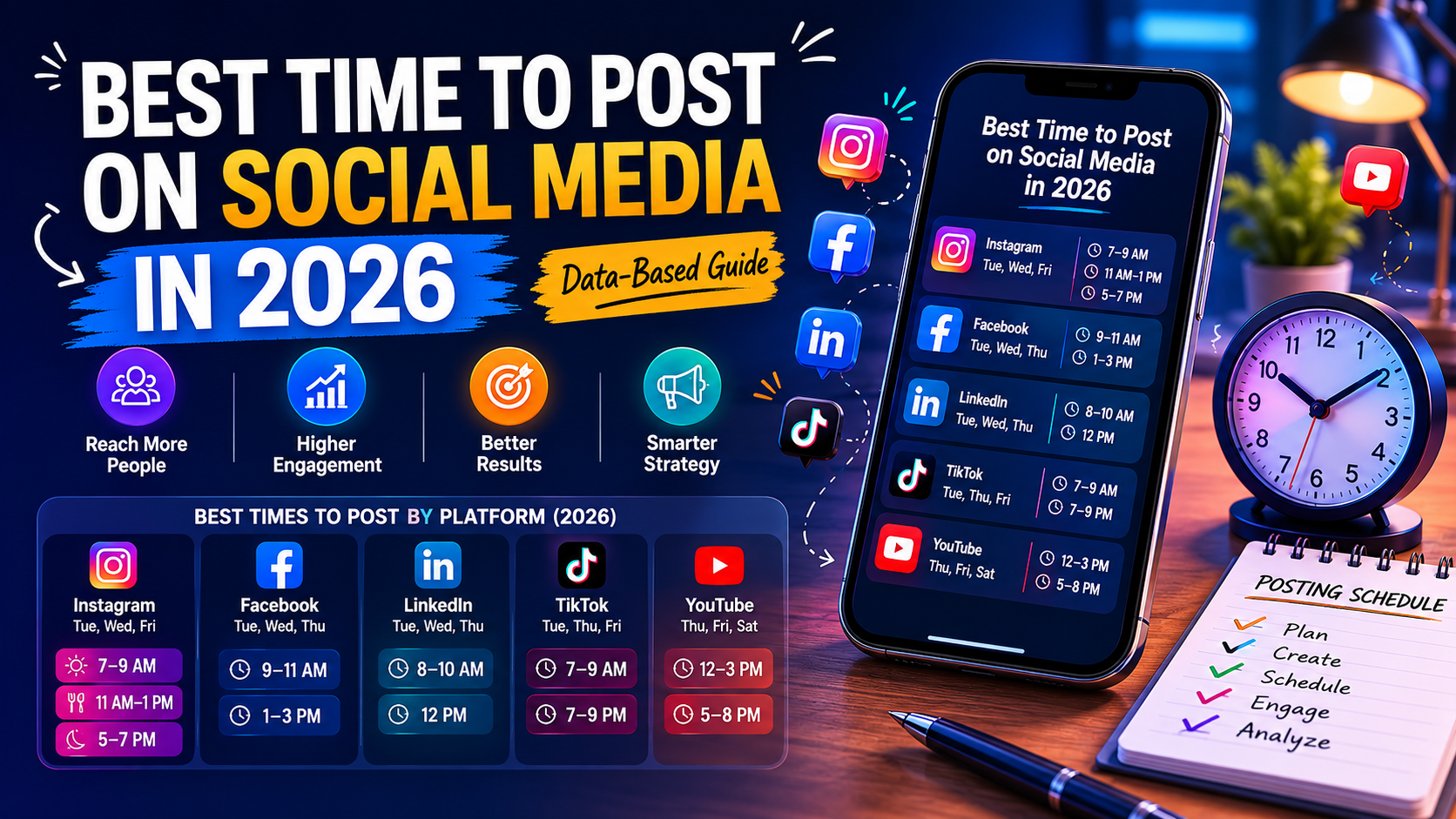
Platform | Best Days | Peak Windows (Audience Local Time) |
Tuesday, Wednesday, Friday | 7–9 AM · 11 AM–1 PM · 5–7 PM | |
Tuesday, Wednesday, Thursday | 9–11 AM · 1–3 PM | |
Tuesday, Wednesday, Thursday | 8–10 AM · 12 PM | |
TikTok | Tuesday, Thursday, Friday | 7–9 AM · 7–9 PM |
YouTube | Thursday, Friday, Saturday | 12–3 PM · 5–8 PM |
These windows are strong baselines—not guarantees. What follows explains the reasoning behind each, how to adapt them for your audience, and where most brands go wrong.
Every major social platform uses an engagement-velocity signal in its ranking system. Content that earns fast reactions gets broader distribution. Content that sits quiet gets less.
Sprout Social’s 2024 benchmark data found that posts published during peak audience hours saw engagement rates 20–30% higher than identical content posted off-peak. That gap compounds. A brand consistently hitting those windows builds algorithmic momentum; one that doesn’t often wonders why reach keeps declining despite producing solid content.
The practical takeaway: optimizing timing doesn’t change what you post — it changes the conditions the algorithm uses to decide whether to amplify it. For growing brands, including many working with teams like ClickFixs on social media growth, this is often the first lever worth pulling.
Instagram’s algorithm currently weights saves, shares, and comments more heavily than passive likes. That means early, high-quality engagement isn’t just about vanity metrics — it directly determines how far your content travels.
Based on aggregated benchmark data, the best time to post on Instagram sits in three consistent windows: 7–9 AM (pre-work phone checks), 11 AM–1 PM (lunch browsing), and 5–7 PM (the afterwork scroll). Tuesdays and Wednesdays are the strongest performing weekdays across most verticals.
For Reels: Evening posting between 7–10 PM outperforms other windows on video completion rate — which is Instagram’s primary signal for Reels distribution. A Reel that holds viewers to the end will be pushed into non-follower feeds. Timing your publish to catch active users increases the probability of that first-hour completion data.
For Stories: Morning windows (8–10 AM) and midday (12–1 PM) consistently produce the strongest tap-through rates. Stories are consumptive and sequential — users move through them fast, so getting into that morning session is where viewership peaks.
Actionable takeaway: Schedule your highest-effort posts for Tuesday or Wednesday morning. Use evening slots for Reels. Avoid posting between 10 PM and 6 AM unless your analytics show a night-owl audience.
Facebook’s user base has matured, and its usage patterns have shifted accordingly. The platform sees the highest engagement during work-adjacent break moments — early mornings, lunch hours, and mid-afternoon pauses.
Published benchmarks consistently point to Tuesday, Wednesday, and Thursday as the top-performing days, with the strongest windows landing between 9–11 AM and 1–3 PM. Friday afternoons drop off significantly, and weekend performance varies sharply by content type and audience.
One tactic worth noting from agency experience: Facebook Groups generate meaningfully higher organic engagement than brand Pages in the current algorithm environment. If you’re managing a community or a niche interest group alongside your main Page, weekday evening posts (7–9 PM) see solid engagement as members catch up on discussions after work.
For local businesses running event-based or time-sensitive content, Saturday morning posts (8–10 AM) can outperform weekday windows — particularly when boosted even modestly.
Actionable takeaway: Default to Tuesday–Thursday mornings for reach-focused posts. If you manage a Facebook Group, test Wednesday and Thursday evenings. Don’t write off weekends for local or event-driven content.
LinkedIn is the platform where timing precision matters most—because the professional context means user availability and mindset shift dramatically across the day and week.
According to LinkedIn’s own published research and third-party benchmarks, the best time to post on LinkedIn in 2026 clusters tightly around Tuesday, Wednesday, and Thursday, with peak windows at 8–10 AM and noon. These align with when professionals are between tasks and more likely to engage with content thoughtfully rather than impulsively.
Monday mornings underperform—people are clearing inboxes and catching up after the weekend. Friday afternoons are the lowest-performing window on the platform by a considerable margin.
For B2B brands and consultants, LinkedIn analytics consistently show that long-form posts and carousels scheduled for Wednesday 9 AM outperform the same content published at other times — often by 40–60% in impressions.
Posting frequency compounds here. Accounts that publish 3–4 times per week at consistent times build algorithmic credibility over 60–90 days. Sporadic posting, even well-timed, doesn’t produce the same results.
Actionable takeaway: Pin your best LinkedIn content on Wednesday between 8 and 10 AM. Maintain a minimum of 3 posts per week. Check your analytics monthly and note the time stamps of your top five performing posts—the pattern usually becomes clear within 45 days.
TikTok runs on a discovery-first model, which makes its algorithm somewhat more forgiving on timing than Instagram — a strong video can surface days or weeks after it’s posted. That said, early engagement still increases the probability of algorithmic amplification, particularly within the first six hours. Peak activity lands at 7–9 AM and 7–9 PM, with Tuesday, Thursday, and Friday delivering the most consistent results across entertainment, education, and product niches.
YouTube operates fundamentally differently from every other platform because its primary driver is search, not browsing. Users come to YouTube with intent. That means upload timing is less about catching a scroll and more about being indexed and recommended in the hours after you publish. The strongest upload window is Thursday or Friday between noon and 3 PM — this positions videos to capture the afterwork and weekend viewing surge, which historically represents peak YouTube consumption. Saturday works well for entertainment, lifestyle, and tutorial content specifically.
Actionable takeaway: For TikTok, prioritize the AM and PM bookend windows. For YouTube, publish Thursday or Friday midday and allow the weekend audience to find your content organically through search and suggested feeds.
General benchmarks are a starting point — but industry context shifts timing meaningfully. Here’s how it plays out across key verticals:
B2B: LinkedIn is the primary channel. Tuesday–Thursday, 8–10 AM is the most reliable window. Decision-makers check LinkedIn before their first meetings of the day, not after.
SaaS: Midweek mornings (8–10 AM, Tuesday–Thursday) on LinkedIn outperform. Product updates and feature releases do especially well on Tuesdays — far enough from the Monday scramble, early enough to drive mid-week conversation.
E-commerce: Instagram and TikTok are the core platforms. Weekday evenings (7–9 PM) drive the highest purchase-intent traffic. Thursday evenings are particularly strong ahead of weekend shopping behavior.
Local Businesses: Facebook still delivers meaningful hyper-local reach. Wednesday midday and Saturday mornings (8–10 AM) work well for promotions and event announcements. Instagram Stories on Tuesday–Thursday mornings also perform consistently for local service businesses.
Healthcare: Educational content on Facebook and Instagram peaks late morning (10 AM–12 PM) on weekdays. Health audiences tend to consume content during personal downtime rather than commutes or workdays. Evening hours underperform in most healthcare categories.
Education: Instagram and TikTok see peak engagement from student audiences between 3–5 PM on weekdays (post-school hours) and Saturday mornings. For B2B education content targeting administrators or educators, LinkedIn’s standard Tuesday–Thursday morning pattern holds.
For brands targeting a national or international audience, time zone alignment is often the invisible factor behind inconsistent engagement.
The clearest rule: post in your audience’s primary time zone, not yours. Every major scheduling tool and native analytics dashboard shows geographic breakdowns — use them. If 65% of your followers are on the East Coast, publish in Eastern Time even if you’re based elsewhere.
For audiences split across multiple regions, prioritize your highest-value segment. A U.S. B2B brand selling to enterprise clients in New York and Chicago should anchor to Eastern Time — that approach still catches West Coast followers during their late morning.
Global brands with no dominant regional audience often benefit from split scheduling: one publish window for North American prime time, a separate one for EMEA mornings. Most scheduling tools support this without manual effort each time.
Even with the right schedule, these patterns consistently kill performance:
Posting and going dark. The first 30–60 minutes after publishing are the highest-leverage window you have. Brands that log off immediately after posting lose the engagement loop that tells the algorithm the content is worth amplifying. Block time to respond to early comments.
Relying entirely on general benchmarks. This guide gives you a strong starting framework — but your account’s social media analytics will always be more accurate than industry averages. Audit your top 10 posts from the last 90 days and note when they were published.
Inconsistent scheduling. Algorithms favor accounts with predictable, regular posting patterns. A brand that posts five times one week and once the next doesn’t build compounding momentum. A consistent social media posting schedule — even at moderate frequency — outperforms irregular high-volume posting over time.
Platform uniformity. Scheduling the same post at the same time across all platforms is a common shortcut that costs performance. Each platform has distinct audience behavior, and what works at 6 PM on Instagram actively underperforms at 6 PM on LinkedIn.
Buffer offers clean scheduling across all major platforms with timing recommendations drawn from your account’s own engagement history — a solid choice for solo operators and small teams.
Later centers on Instagram with a visual content calendar that pairs scheduling with creative planning. Its “Best Time to Post” feature pulls from your specific account data rather than generic averages.
Sprout Social is the most data-rich option for teams managing multiple accounts. Its post-performance-by-hour breakdowns make timing optimization systematic rather than guesswork.
Hootsuite covers broad platform support with solid team collaboration, though its post-level analytics are less granular than Sprout’s.
What is the worst time to post on social media? Late nights (10 PM–5 AM) consistently produce the lowest engagement across all platforms for most audiences. Monday mornings and Friday afternoons also underperform relative to midweek—particularly on LinkedIn and Facebook.
Does posting time affect reach? Yes, directly. Platforms use early engagement velocity as a distribution signal. Content published when your audience is active collects faster initial reactions, which algorithms interpret as a quality indicator and reward with broader reach. The effect is most pronounced on Instagram and TikTok.
How do I find my best posting time? Open your native analytics dashboard—Instagram Insights, LinkedIn Analytics, or Meta Business Suite—and look for “Audience Activity” or “When your followers are online.” Cross-reference those peak hours with the timestamps on your best-performing posts from the last 60–90 days. Where the two data sets overlap is your optimal window.
Should I post every day? It depends on the platform. Daily posting benefits TikTok and Facebook. Instagram performs well at 4–5 times per week. LinkedIn peaks at 3–4 times per week—more than that can reduce per-post reach as impressions spread thin. Across all platforms, a consistent moderate-frequency schedule outperforms irregular high-volume posting.
Does posting time matter more than content quality? No. Timing amplifies content — it doesn’t rescue weak content. A well-timed mediocre post still underperforms. But strong content at the wrong time reliably falls short of its potential. Both need to work in the same direction.
Timing is leverage. It doesn’t create great content, but it determines whether great content gets seen.
Start with the platform-specific windows in this guide. Run a consistent schedule for 30 days. Then pull your analytics, look at your top five posts by reach and engagement, and note the publish times. The pattern almost always points to a specific window that outperforms the rest for your audience — and that’s where you double down.
The brands dominating their categories on social media in 2026 aren’t just producing better content. They’re publishing it at the exact moment their audience is most ready to receive it. That’s a gap you can close this week.