clickfixs.com

Uncategorized

Difference Between Organic and Paid Social Media Marketing

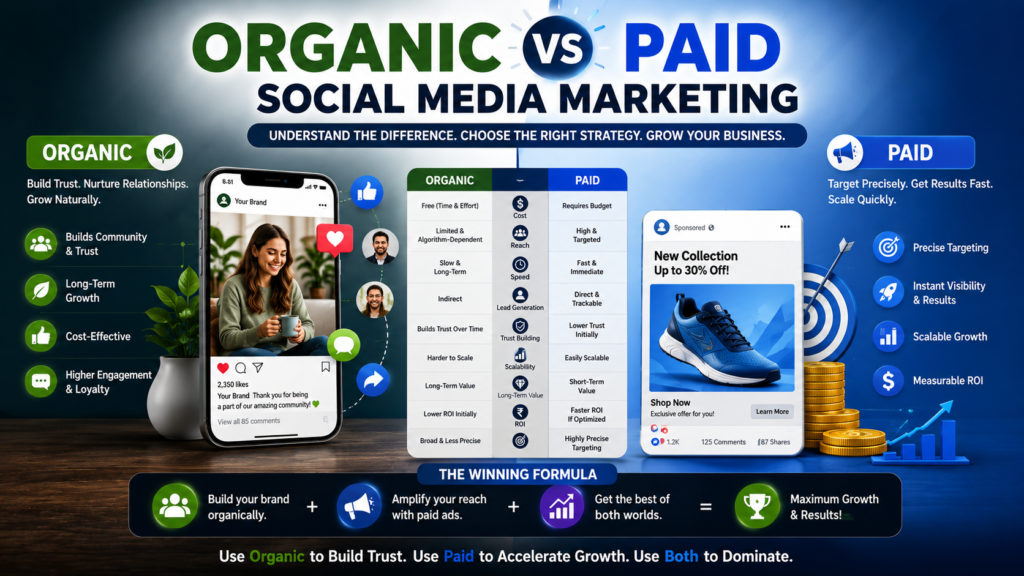
Difference Between Organic and Paid Social Media Marketing “Should I focus on building our organic social media, or should I just invest in paid ads?” If you are a business owner or marketing manager, you have likely asked yourself this exact question. It is one of the most common dilemmas in digital marketing. On one hand, you see brands going viral with creative videos without spending a dime on ad placements. On the other hand, you hear about e-commerce stores scaling from zero to millions by dialing in their paid advertising framework. When you are managing a growing business, time and budget are your most finite resources. Misallocating either hurts your bottom line. The truth is, choosing between organic and paid social media marketing is not an either/or proposition. Both serve entirely different functions in your growth funnel. Understanding how they operate individually—and how they amplify each other when combined—is the key to building a sustainable social media marketing strategy. Let’s break down how both channels function, map out their core differences, and look at how real-world businesses leverage them for maximum revenue growth. What Is Organic Social Media Marketing? Organic social media marketing refers to any free content you share on social media platforms without paying for distribution. This includes your daily posts, images, long-form articles, stories, reels, and direct interactions with your audience in the comments section. How It Works When you post organically, the platform’s algorithm determines who sees your content based on relevance, engagement signals (likes, shares, comments), and user behavior. Your primary audience consists of your existing followers, plus a small percentage of non-followers if your content receives high engagement or hits trending audio and hashtags. Real-World Business Examples The Local D2C Brand: A sustainable clothing brand in Mumbai posts behind-the-scenes Instagram Reels showing how their artisans dye fabrics. Viewers connect with the craftsmanship, leave comments, and share the video with friends. The B2B Consultant: A SaaS marketing consultant based in New York posts a detailed case study on LinkedIn explaining how they lowered churn by 15%. Other tech founders read it, bookmark it, and view the consultant as an industry authority. Benefits Zero Direct Ad Cost: Publishing content costs nothing but your time and creative effort. Builds Deep Authenticity: It gives your brand a human voice, allowing you to nurture relationships and build long-term customer trust. Acts as a Digital Storefront: When potential customers search for your business, your organic profiles show them that your company is active, legitimate, and responsive. Limitations Declining Organic Reach: Algorithmic shifts have systematically lowered organic reach across platforms like Facebook and Instagram. You can no longer rely on organic posts to reach 100% of your own followers, let alone new audiences. Slow Pipeline Velocity: Building a highly engaged organic community takes months, sometimes years, of consistent posting. What Is Paid Social Media Marketing? Paid social media marketing involves paying a platform to display your content to specific target audiences who do not necessarily follow your brand. This encompasses sponsored posts, video ads, lead-generation forms, and carousel ads managed through tools like Meta Ads Manager, LinkedIn Campaign Manager, or TikTok Ads. How It Works You set a budget, choose a specific business objective (such as website traffic, lead generation, or conversions), and define your target audience using demographics, interests, behaviors, or custom data. The platform then distributes your ads into users’ feeds, labeling them as “Sponsored.” Real-World Business Examples The E-commerce Store: An international footwear brand launches a Meta catalog ad targeting users who visited their website but left without buying. The ad displays the exact shoes the user viewed, offering a 10% discount to close the sale. The Local Service Business: A dental clinic in Delhi runs hyper-local Facebook ads targeted within a 5-kilometer radius of their office, offering a complimentary teeth-cleaning consultation to generate direct phone inquiries. Benefits Instant Visibility: Your message bypasses the organic algorithm and appears directly in front of prospects the moment your campaign goes live. Precision Targeting: You can target prospects based on exact variables—such as job titles, specific purchasing habits, geographic location, or lookalike audiences modeled after your best customers. Predictable Scalability: If you spend $100 and generate $300 in revenue, you can systematically increase your ad budget to scale your sales volume. Limitations Requires Consistent Capital: The moment you pause your ad spend, your traffic, lead flow, and sales from that channel drop to zero. Ad Fatigue and Costs: Ad costs fluctuate based on competition, auction dynamics, and season. Additionally, if you don’t refresh your creative assets regularly, audiences tune out your ads. Organic vs Paid Social Media Marketing: Key Differences To help you visualize how these strategies contrast, here is a breakdown across core business factors: Factor Organic Social Media Paid Social Media Direct Cost Free to publish (only costs time/production). Requires ongoing media spend. Reach Limited to followers and a small algorithmic sliver. Guaranteed placement to targeted non-followers. Speed Slow, iterative, long-term build. Immediate traffic and visibility. Lead Generation Indirect; relies on profile links and bio calls-to-action. Direct; uses native forms and landing page clicks. Trust Building High; community perceives it as authentic value. Moderate; users know they are being sold to. Scalability Hard to scale predictably; tied to algorithm volatility. Highly scalable by increasing ad budget. Audience Targeting Broad; determined by platform algorithms. Granular; based on custom data and demographics. Primary ROI Metric Engagement rate, community sentiment, retention. Cost Per Lead (CPL), Customer Acquisition Cost (CAC), ROAS. Pros and Cons Matrix Organic Social Media Marketing Advantages: Establishes a permanent digital asset; drives compound interest over time; lowers overall customer acquisition costs over the long run. Disadvantages: Subject to sudden algorithm updates; demands high creative output; impossible to predict short-term revenue outcomes. Best Use Cases: Brand storytelling, customer support, community engagement, educating your market, and retaining existing clients. Paid Social Media Marketing Advantages: Guaranteed visibility; perfect for time-sensitive promotions; clean attribution tracking back to specific creative variants. Disadvantages: Requires technical media-buying expertise; high upfront financial risk if campaigns
Uncategorized

How to Generate Leads from Social Media Without Paid Ads

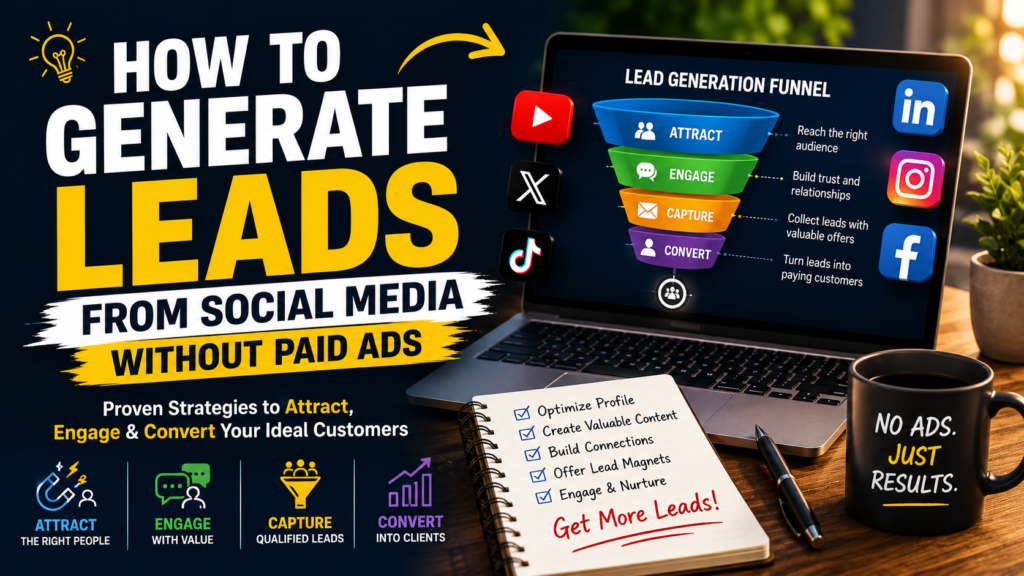
How to Generate Leads from Social Media Without Paid Ads The multi-million dollar ad campaigns dominating your feed want you to believe a flat-out lie: “If you aren’t paying for ads, your business is invisible on social media.” It’s easy to see why people fall for this. Algorithms change, organic reach dips, and ad platforms make billions by convincing you that a credit card is the only key to the kingdom. But here is the reality: Paid ads buy visibility, not trust. When you strip away the sponsored tags, social media remains a massive, interconnected network of real human beings looking for solutions to their problems. By shifting your approach from chasing algorithmic loops to building a structured organic lead generation framework, you can turn your social profiles into 24/7 client-acquisition machines. You don’t need a massive ad budget to land high-ticket clients or eager buyers. You just need a system that translates attention into revenue. Why Most Businesses Fail at Organic Social Media Marketing If organic social media lead generation is so effective, why are most business owners staring at empty pipelines? It usually comes down to three structural flaws in their social media marketing for businesses: Chasing Likes Instead of Leads: A viral video of an office dog might get 50,000 views and 3,000 likes, but if you sell B2B supply chain software, exactly zero of those likes will turn into a discovery call. Vanity metrics do not pay the payroll. The “Me, Me, Me” Content Loop: Most company pages look like digital brochures. They post about their new hires, their anniversary, or a generic “hire us” graphic. Your audience doesn’t care about your company milestone; they care about their own unresolved problems. The Invisible Doorway: Businesses often post great educational content but fail to give the reader a clear, frictionless next step. If a prospect has to hunt through your website just to figure out how to work with you, you’ve already lost them. Shifting Focus: Engagement vs. Genuine Lead Generation To win without ads, you must understand that entertainment and lead generation are two entirely different sports. [Entertainment/Engagement] -> Likes, Shares, Comments, Algorithmic Reach [Lead Generation Strategy] -> Captured Emails, Booked Calls, Direct Message Inquiries A follower is a vanity metric; a prospect is an asset. When you focus on organic lead generation, you stop trying to please the algorithm and start trying to please a very specific buyer. The beautiful paradox of organic leads is that they are almost always higher quality than paid leads. A paid ad catches someone while they are browsing, forcing them through a cold funnel. An organic lead has consumed your content, vetted your expertise over time, and self-selected to raise their hand. They don’t need to be sold on who you are; they just need to know how you can help them. Step 1: Optimize Your Profile for Social Media Conversion Think of your social media profile as a landing page. When a potential customer clicks your name after seeing a helpful post or comment, your profile has less than five seconds to answer three critical questions: What do you do? Who do you do it for? What should they do next? The Profile Optimization Blueprint The Headline/Bio (The Value Prop): Eliminate generic titles like “CEO & Founder.” Replace it with a clear transformation hook. Weak: “Digital Marketing Expert & Consultant.” Strong: “We help mid-sized SaaS companies scale from $1M to $5M ARR via organic search. Book a free growth audit below 👇” The Action-Oriented Link: Never drop a naked link to your homepage. Use a dedicated link that leads directly to a high-value resource or booking page. If you use a multi-link tool (like Linktree), keep choices limited to three options max to prevent decision paralysis. The Lead Magnet Gateway: Tie your bio link directly to an immediate piece of value. B2B Agency Example: A free Notion template tracking competitor ad spend. Local Fitness Studio Example: A downloadable 7-day meal plan tailored to working professionals in your city. Step 2: Create Content That Attracts Buyers, Not Tourists To generate leads from social media, your content pillars must shift away from general industry news toward high-intent assets. 1. The Tear-Down / Case Study Why it works: It proves you can deliver results before a client ever speaks to you. It shifts you from an applicant to an authority. Example: A detailed breakdown of how you helped a local Delhi-based D2C brand slash its cart abandonment rate by 22% using three simple email automation tweaks. Lead Benefit: High-intent prospects read this and think, “They understand my exact issue and have already solved it for someone else.” 2. The Specific Problem-Solver Why it works: It gives away the “what” and the “why” for free, while positioning your business as the logical “how.” Example: A carousel post outlining the exact checklist compliance auditors look for when vetting corporate financial setups. Lead Benefit: Builds immense goodwill and isolates readers who actively need this checklist managed for them. 3. The Contrarian Insight Why it works: It cuts through the noise of generic advice and shows deep, experiential industry knowledge. Example: “Why standard SEO keyword research tools are making you target the wrong audience in 2026—and what we do instead.” Lead Benefit: Positions your business as an innovative leader rather than a copycat service provider. 10 Proven Ways to Generate Leads Without Paid Ads Here are ten actionable tactics you can deploy across your networks starting today to source high-quality social media leads. 1. Value-First Content Upgrades Instead of telling people to visit your website, tell them to leave a comment to get a resource. How it works: Post a high-value summary of a strategy, then end with: “Comment ‘STRATEGY’ below, and I’ll DM you the full 12-page PDF playbook.” Why it works: Comments trigger the platform’s algorithm, pushing your post to a wider audience, while creating an open door in the DMs to start a real business conversation. Real-World Example: A boutique real

Uncategorized

 Content Ideas for Businesses on Social Media (50+ Ideas)

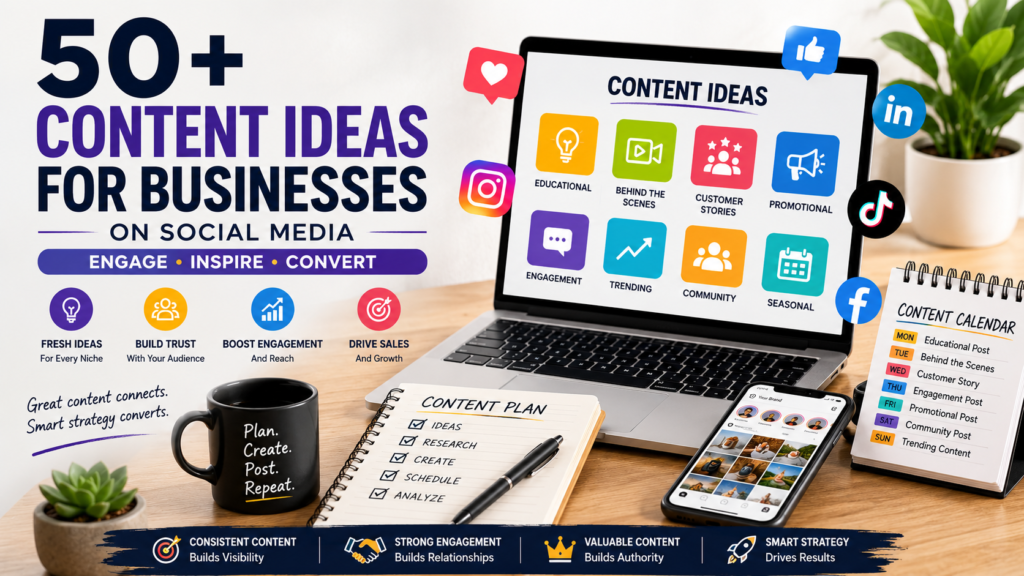
Content Ideas for Businesses on Social Media (50+ Ideas) We have all been there. You open Instagram, LinkedIn, or Facebook, stare at the “Create a Post” window, and… nothing. The blinking cursor mocks you. You know you need to post to keep your audience engaged, but your mind is a total blank. Running out of content ideas for businesses is one of the most common hurdles in digital marketing. Yet, maintaining a consistent presence is non-negotiable. Consistent posting trains the algorithms to favor your page, builds familiarity with your audience, and establishes your brand as an authority. When you stop posting, you effectively become invisible to your potential customers. To break that creative block, you need a repeatable social media content strategy. Let’s dive into a massive library of 50+ proven social media content ideas that will keep your feeds active, engaging, and profitable. What Makes Social Media Content Successful? Before throwing spaghetti at the digital wall, it helps to know what sticks. The most successful business social media posts achieve a balance between three elements: Value: Does it teach, entertain, or solve a problem? Relatability: Does it sound like a human or a corporate robot? Actionability: Is it clear what the user should do next (like, comment, share, or buy)? High social media engagement happens when your audience sees themselves in your content. Here are over 50 ideas categorized by purpose to help you fill your content calendar. 50+ Social Media Content Ideas for Businesses 1. Educational Content (Build Authority) 1. The “How-To” Guide: Break down a complex process into 3 simple steps. Example: A Delhi-based boutique hotel sharing “How to pack a suitcase to avoid wrinkles.” 2. Industry Myth-Busting: Call out a common misconception. Example: An SEO agency posting, “Why buying backlinks will ruin your website in 2026.” 3. Quick Tips & Hacks: Share a shortcut your audience can use today. Example: A SaaS startup sharing a keyboard shortcut that saves 10 minutes a day. 4. Definition of Terms: Explain industry jargon in plain language. Example: A financial advisor explaining what “dollar-cost averaging” means. 5. Infographics: Visualize data or a checklist. Example: A real estate agent sharing a chart of the home-buying timeline. 6. Book/Podcast Recommendations: Share resources that helped you grow. Example: A business coach sharing their top 3 leadership books. 7. Common Mistakes to Avoid: Warn your audience about pitfalls. Example: A fitness trainer posting “3 reasons your squat isn’t building muscle.” 8. Frequently Asked Questions (FAQ): Answer a question your sales team gets constantly. Example: A custom bakery answering, “How far in advance do I need to order a wedding cake?” 2. Behind-the-Scenes Content (Build Trust) 9. A Day in the Life: Show a hyper-lapse or vlog of your daily routine. Example: A cafe owner showing their 5:00 AM opening routine. 10. Meet the Team: Introduce an employee and share a fun fact about them. Example: “Meet Priya, our lead developer who runs marathons on weekends.” 11. Packaging Orders: Film a satisfying video of preparing a customer’s package. Example: An e-commerce jewelry brand wrapping a delicate necklace. 12. Workspace Tour: Show where the magic happens. Example: A remote graphic designer showing their minimalist desk setup. 13. Product Ideation: Share early sketches or brainstorming sessions for a new launch. Example: A clothing brand showing fabric swatches for next season. 14. Bloopers & Outtakes: Show that your team doesn’t take itself too seriously. Example: Blunders from a recent corporate photoshoot. 15. Company Milestone Celebrations: Celebrate your anniversary or your 1,000th customer. Example: A SaaS startup celebrating 5 years with a team cake-cutting video. 16. Tools of the Trade: Show the software or physical machinery you can’t live without. Example: A woodworker showcasing their favorite carving chisel. 3. Customer-Focused Content (Social Proof) 17. User-Generated Content (UGC): Repost a photo a customer took of your product. Example: A skincare brand sharing a customer’s shelfie. 18. Case Studies: Share a before-and-after transformation with hard metrics. Example: A digital marketing agency showing how they boosted a client’s ROI by 40%. 19. Screenshot Testimonials: Share a kind DM, text message, or Google review (with permission). Example: A local plumber sharing a text from a relieved homeowner. 20. Customer Spotlight: Interview a loyal customer about their journey. Example: A gym interviewing a member who just hit their personal best. 21. Overcoming Objections: Address a reason someone might hesitate to buy. Example: An eco-friendly brand explaining why their sustainable materials cost a bit more but last 5x longer. 22. Thank You Notes: A heartfelt post thanking your community for their ongoing support. Example: A ceramic artist thanking followers after a sold-out shop update. 23. Answering Customer Comments: Take a comment from a previous post and answer it via video. Example: A makeup brand demonstrating a specific application technique requested by a follower. 4. Promotional Content (Drive Sales) 24. Flash Sales: Announce a limited-time discount. Example: “20% off for the next 4 hours only!” 25. Product Demonstrations: Show your product in action, solving a real problem. Example: A kitchen gadget company showing how easily their chopper cuts onions without tears. 26. New Launch Teasers: Build hype with close-up shots and mystery countdowns. Example: A tech startup showing a silhouette of a new device. 27. Limited-Edition Drops: Highlight scarcity. Example: A luxury streetwear brand announcing only 100 jackets are available. 28. Client Transformations: Focus on the emotional shift after using your service. Example: A career coach showing a client moving from “burnt out” to “landing a dream executive role.” 29. Special Bundles: Group products together for a discounted price. Example: A coffee roaster offering a “Mug + Blend” holiday gift set. 30. Freebies & Lead Magnets: Promote a free guide or template in exchange for an email. Example: A financial planner offering a free budget spreadsheet link in bio. 31. Hard Pitch: Directly state what you sell, who it’s for, and how to buy it. Example: A copywriter opening spots for their quarterly retainer services. 5. Engagement Posts (Boost Algorithm Reach) 32. “This or That”

Uncategorized

 Best Time to Post on Social Media in 2026 (Data-Based Guide)

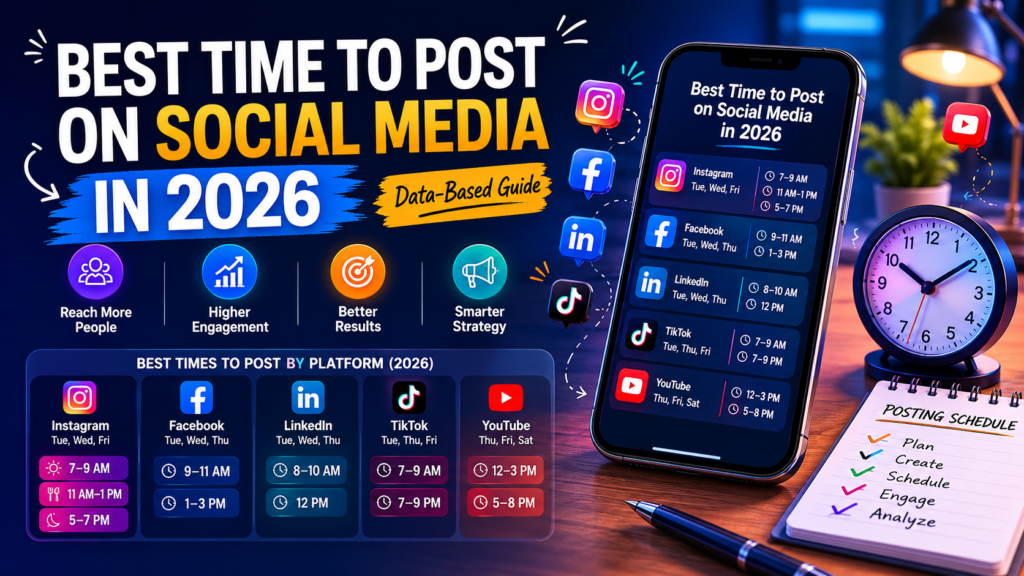
Best Time to Post on Social Media in 2026 (Data-Based Guide) You spend hours crafting the perfect post — the copy is sharp, the visual is on point, the caption earns its hook. Then you hit publish and… crickets. Most people blame the content. But after working across dozens of brand accounts and client campaigns, one pattern shows up again and again: the content was fine. The timing wasn’t. In 2026, platform algorithms don’t just reward quality — they reward immediate engagement. The first 30 to 60 minutes after you publish determine whether your post gets amplified to thousands of new viewers or quietly deprioritized in an already crowded feed. Understanding the best time to post on social media in 2026 isn’t a tactical nicety. It’s foundational to any social media marketing strategy that actually works. The data below draws from aggregated platform research, published benchmarks from Sprout Social, HubSpot, and Later, and real-world observations across multiple industries. Where 2026-specific data isn’t yet published, recommendations reflect current benchmarks and confirmed platform behavior trends. Quick Reference: Best Times to Post by Platform (2026) Platform Best Days Peak Windows (Audience Local Time) Instagram Tuesday, Wednesday, Friday 7–9 AM · 11 AM–1 PM · 5–7 PM Facebook Tuesday, Wednesday, Thursday 9–11 AM · 1–3 PM LinkedIn Tuesday, Wednesday, Thursday 8–10 AM · 12 PM TikTok Tuesday, Thursday, Friday 7–9 AM · 7–9 PM YouTube Thursday, Friday, Saturday 12–3 PM · 5–8 PM These windows are strong baselines—not guarantees. What follows explains the reasoning behind each, how to adapt them for your audience, and where most brands go wrong. Why Posting Time Has a Measurable Impact on Reach Every major social platform uses an engagement-velocity signal in its ranking system. Content that earns fast reactions gets broader distribution. Content that sits quiet gets less. Sprout Social’s 2024 benchmark data found that posts published during peak audience hours saw engagement rates 20–30% higher than identical content posted off-peak. That gap compounds. A brand consistently hitting those windows builds algorithmic momentum; one that doesn’t often wonders why reach keeps declining despite producing solid content. The practical takeaway: optimizing timing doesn’t change what you post — it changes the conditions the algorithm uses to decide whether to amplify it. For growing brands, including many working with teams like ClickFixs on social media growth, this is often the first lever worth pulling. Best Time to Post on Instagram in 2026 Instagram’s algorithm currently weights saves, shares, and comments more heavily than passive likes. That means early, high-quality engagement isn’t just about vanity metrics — it directly determines how far your content travels. Based on aggregated benchmark data, the best time to post on Instagram sits in three consistent windows: 7–9 AM (pre-work phone checks), 11 AM–1 PM (lunch browsing), and 5–7 PM (the afterwork scroll). Tuesdays and Wednesdays are the strongest performing weekdays across most verticals. For Reels: Evening posting between 7–10 PM outperforms other windows on video completion rate — which is Instagram’s primary signal for Reels distribution. A Reel that holds viewers to the end will be pushed into non-follower feeds. Timing your publish to catch active users increases the probability of that first-hour completion data. For Stories: Morning windows (8–10 AM) and midday (12–1 PM) consistently produce the strongest tap-through rates. Stories are consumptive and sequential — users move through them fast, so getting into that morning session is where viewership peaks. Actionable takeaway: Schedule your highest-effort posts for Tuesday or Wednesday morning. Use evening slots for Reels. Avoid posting between 10 PM and 6 AM unless your analytics show a night-owl audience. Best Time to Post on Facebook in 2026 Facebook’s user base has matured, and its usage patterns have shifted accordingly. The platform sees the highest engagement during work-adjacent break moments — early mornings, lunch hours, and mid-afternoon pauses. Published benchmarks consistently point to Tuesday, Wednesday, and Thursday as the top-performing days, with the strongest windows landing between 9–11 AM and 1–3 PM. Friday afternoons drop off significantly, and weekend performance varies sharply by content type and audience. One tactic worth noting from agency experience: Facebook Groups generate meaningfully higher organic engagement than brand Pages in the current algorithm environment. If you’re managing a community or a niche interest group alongside your main Page, weekday evening posts (7–9 PM) see solid engagement as members catch up on discussions after work. For local businesses running event-based or time-sensitive content, Saturday morning posts (8–10 AM) can outperform weekday windows — particularly when boosted even modestly. Actionable takeaway: Default to Tuesday–Thursday mornings for reach-focused posts. If you manage a Facebook Group, test Wednesday and Thursday evenings. Don’t write off weekends for local or event-driven content. Best Time to Post on LinkedIn in 2026 LinkedIn is the platform where timing precision matters most—because the professional context means user availability and mindset shift dramatically across the day and week. According to LinkedIn’s own published research and third-party benchmarks, the best time to post on LinkedIn in 2026 clusters tightly around Tuesday, Wednesday, and Thursday, with peak windows at 8–10 AM and noon. These align with when professionals are between tasks and more likely to engage with content thoughtfully rather than impulsively. Monday mornings underperform—people are clearing inboxes and catching up after the weekend. Friday afternoons are the lowest-performing window on the platform by a considerable margin. For B2B brands and consultants, LinkedIn analytics consistently show that long-form posts and carousels scheduled for Wednesday 9 AM outperform the same content published at other times — often by 40–60% in impressions. Posting frequency compounds here. Accounts that publish 3–4 times per week at consistent times build algorithmic credibility over 60–90 days. Sporadic posting, even well-timed, doesn’t produce the same results. Actionable takeaway: Pin your best LinkedIn content on Wednesday between 8 and 10 AM. Maintain a minimum of 3 posts per week. Check your analytics monthly and note the time stamps of your top five performing posts—the pattern usually becomes clear within 45 days. Best Posting Times for TikTok

Uncategorized

 How Instagram Algorithm Works in 2026 (Complete Guide)

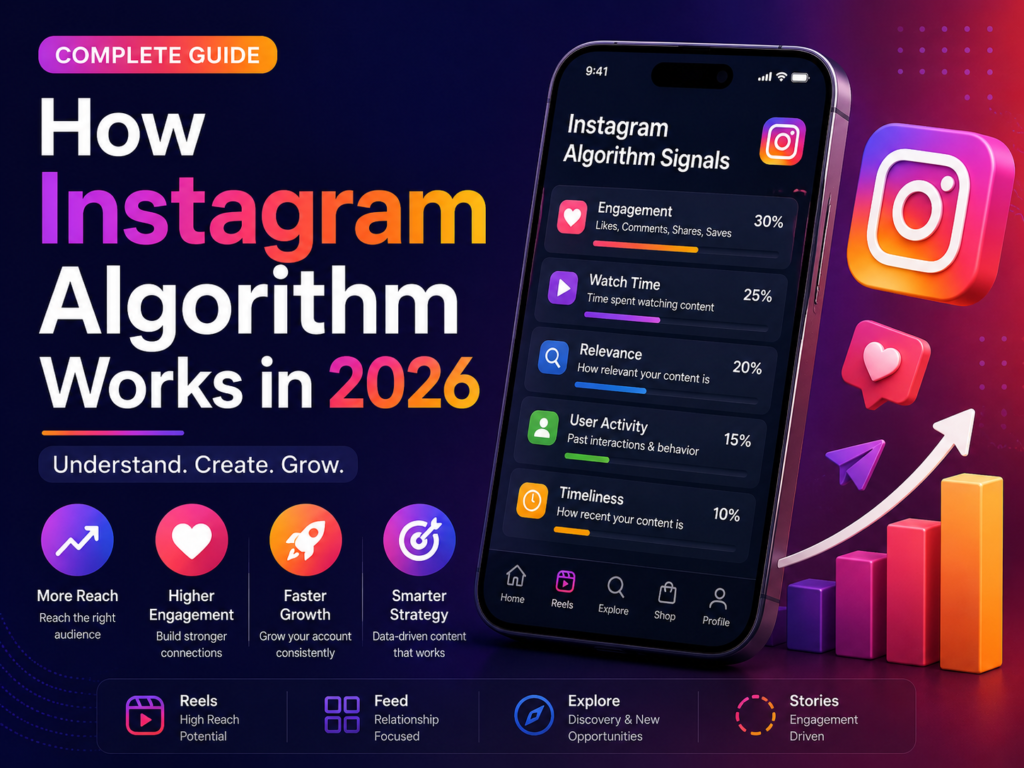
How Instagram Algorithm Works in 2026 (Complete Guide) Introduction If your posts aren’t getting the reach you expect, you’re not alone. Understanding the instagram algorithm 2026 is essential if you want consistent and predictable growth. Instagram is no longer a chronological platform—it is driven by user behavior, engagement signals, and content relevance. The instagram algorithm 2026 decides what content appears, who sees it, and how far it reaches. This means even high-quality posts can fail if they are not aligned with how the system works. Once you understand the instagram algorithm 2026, you can stop guessing and start building a strategy that delivers results. Instagram continuously evolves, and the instagram algorithm 2026 adapts based on user activity and platform trends. This makes it important for creators and businesses to stay updated and flexible in their approach. What Is the Instagram Algorithm in 2026? What Is the Instagram Algorithm in 2026? The instagram algorithm 2026 is a ranking system that prioritizes content based on relevance, engagement, and user interaction. Instead of showing posts in chronological order, Instagram filters and displays content that users are most likely to engage with. It is important to understand that the instagram algorithm 2026 is not a single system. It works differently across feed, reels, explore, and stories. Each section uses its own signals, but the main objective remains the same—maximize engagement and keep users active on the platform. Creators who understand how the instagram algorithm 2026 works can position their content better and improve their visibility significantly. Key Factors That Influence Instagram Algorithm 2026 Engagement Signals Engagement is one of the strongest ranking factors in the instagram algorithm 2026. Instagram tracks likes, comments, shares, saves, and watch time to determine how valuable your content is. When your content receives strong engagement early, the instagram algorithm 2026 pushes it to a wider audience. This is why the first few minutes after posting are extremely important for performance. User Interaction History The instagram algorithm 2026 prioritizes content from accounts that users interact with regularly. If someone frequently engages with your posts, they are more likely to see your future content. Building strong relationships with your audience improves consistency and reach within the instagram algorithm 2026. Content Relevance Instagram uses AI to understand your content through captions, hashtags, and visuals. It then matches your content with users who have similar interests. Clear messaging and focused content help the instagram algorithm 2026 distribute your posts more effectively. Consistency Consistency plays a major role in performance. Posting regularly signals that your account is active and reliable. However, consistency should not mean random posting. A structured content plan performs much better within the Instagram algorithm 2026. Content Format Preference Different users prefer different content formats. Some engage more with reels, while others prefer carousels or stories. The instagram algorithm 2026 tracks these preferences and adjusts content visibility accordingly. Understanding this improves your overall performance. How Instagram Algorithm 2026 Works for Reels Reels are currently the most powerful growth tool on the platform. The instagram algorithm 2026 gives them higher visibility because they increase user retention. The system evaluates reels based on watch time, completion rate, replays, and shares. If your reel performs well initially, the instagram algorithm 2026 pushes it to a broader audience. Short, engaging, and attention-grabbing reels perform best. The first few seconds are critical because they determine whether users continue watching. How the Feed Algorithm Works The feed is more relationship-focused. The instagram algorithm 2026 prioritizes content from accounts users interact with frequently. It also considers how recent the post is and how much engagement it receives. To stay visible, your content must remain relevant and consistent. How the Explore Page Works The explore page is designed for discovery. The instagram algorithm 2026 shows content here based on user interests, past behavior, and trending topics. If your content performs well, the instagram algorithm 2026 pushes it beyond your followers, helping you reach a new audience and grow faster. This makes the explore page one of the most important growth opportunities. Common Mistakes That Hurt Your Growth Many creators unknowingly work against the Instagram algorithm 2026. Common mistakes include posting without a clear strategy, ignoring engagement, using irrelevant hashtags, and focusing only on selling. These mistakes reduce your reach because they do not align with how the Instagram algorithm 2026 evaluates content. Advanced Tips to Work-With Instagram Algorithm 2026 To grow consistently, you need to go beyond basic strategies and understand how the Instagram algorithm 2026 behaves in real scenarios. Content retention is a key factor. The longer users stay on your content, the more valuable it appears. This is especially important for reels and carousel posts. Consistency in niche also plays a major role. If your content is scattered, the Instagram algorithm 2026 struggles to identify your target audience. A focused niche improves reach. Saving and sharing behavior is another strong signal. When users save or share your content, it increases its distribution and signals value to the Instagram algorithm 2026. Posting at the right time also improves early engagement, which helps the Instagram algorithm 2026 boost your content faster. Another important factor is content clarity. If your message is confusing, users will scroll away quickly. Clear and structured content performs better within the Instagram algorithm 2026. Additional Insights on Instagram Growth The Instagram algorithm 2026 continues to evolve as user behavior changes across the platform. Strategies that work today may not deliver the same results in the future. Creators who regularly analyze their performance and adapt their approach tend to perform better within the Instagram algorithm 2026. Testing different formats, improving content quality, and focusing on audience engagement are key to long-term success. Data-driven decisions play a major role in growth. Understanding what works and optimizing accordingly helps improve consistency and performance over time. Consistent testing and adapting to new trends ensure better long-term performance within the Instagram algorithm 2026. How to Grow Using Instagram Algorithm 2026 Focus on Value Content that educates, entertains, or solves

Uncategorized

Why Businesses Need a Social Media Agency in 2026

Why Businesses Need a Social Media Agency in 2026 Introduction let’s be honest—almost every business today knows they should be active on social media. But knowing that and actually doing it properly are two completely different things. If you’re trying to grow your business online, working with a social media agency in Delhi can make a real difference. You might already be posting on Instagram or Facebook. Maybe you’ve even tried running ads. But if you’re not seeing consistent results, there’s a reason for that. This is exactly where the question comes in: why businesses need a social media agency in the first place. Social Media Looks Easy, But It Isn’t From the outside, social media feels simple. Post something, add a caption, maybe boost it—done. But when you actually try to grow a business through it, things get complicated. You have to think about: what kind of content people actually engage with when to post for maximum reach how to target the right audience how to turn attention into leads or customers Most business owners simply don’t have the time to figure all of this out. That’s one of the main reasons why businesses choose a social media agency in Delhi today. What Usually Goes Wrong Here’s what typically happens. A business starts strong. They post regularly for a few days or weeks. Maybe they even experiment with different content styles. But then engagement drops, reach becomes inconsistent, and ads don’t perform well. Eventually, consistency breaks. It’s not that social media doesn’t work—it’s just not being handled the right way. That’s why businesses need a social media agency, because strategy matters more than random activity. What a Social Media Agency Actually Does Many people think an agency simply manages posts. In reality, it builds a complete growth system around your business. 1.Clear PlanningEverything starts with understanding your business, audience, and goals. Every action is planned with purpose. 2.Content That ConnectsContent isn’t just about design—it’s about attention and engagement. A good agency creates content people actually care about. 3.Smart AdvertisingAds require strategy. A social media agency ensures your budget is used effectively and optimized for better results. 4.ConsistencyConsistency builds trust. Agencies keep your brand active and visible without breaks. 5.Continuous ImprovementPerformance is tracked and improved over time. Growth comes from data, not guesswork. Doing It Yourself vs Working With an Agency You can manage social media yourself—but results are usually slow and inconsistent. Doing it yourself: limited time trial and error inconsistent results With an agency: expert strategy time saved faster growth That’s why businesses need a social media agency—because experience makes a real difference. What Happens When It’s Done Right When handled properly, social media starts delivering real results. better engagement stronger brand presence more inquiries and leads professional business image At this stage, social media becomes a growth tool—not just a task. Benefits of Hiring a Social Media Agency Better visibility Higher engagement More leads Stronger branding Faster growth These benefits clearly show why businesses need a social media agency in today’s competitive market. Choosing the Right Social Media Agency Not all agencies deliver results. Ask yourself: Do they understand your business? Do they focus on strategy? Are they result-driven? The right agency works like a partner, not just a service provider. Why ClickFixs Can Help At ClickFixs, the focus is simple—clear strategy and consistent execution. We don’t believe in random posting. Everything is planned based on your business goals. From content to campaigns, we focus on what actually works and delivers results. Conclusion Social media is no longer optional—but doing it without strategy won’t help. That’s exactly why businesses need a social media agency—to bring structure, clarity, and real growth. If you’re serious about growing online, it’s time to stop guessing and start building a system that works.

Scroll to Top