If you are a business owner or marketing manager, you have likely asked yourself this exact question. It is one of the most common dilemmas in digital marketing. On one hand, you see brands going viral with creative videos without spending a dime on ad placements. On the other hand, you hear about e-commerce stores scaling from zero to millions by dialing in their paid advertising framework.
When you are managing a growing business, time and budget are your most finite resources. Misallocating either hurts your bottom line.
The truth is, choosing between organic and paid social media marketing is not an either/or proposition. Both serve entirely different functions in your growth funnel. Understanding how they operate individually—and how they amplify each other when combined—is the key to building a sustainable social media marketing strategy.
Let’s break down how both channels function, map out their core differences, and look at how real-world businesses leverage them for maximum revenue growth.
Organic social media marketing refers to any free content you share on social media platforms without paying for distribution. This includes your daily posts, images, long-form articles, stories, reels, and direct interactions with your audience in the comments section.
When you post organically, the platform’s algorithm determines who sees your content based on relevance, engagement signals (likes, shares, comments), and user behavior. Your primary audience consists of your existing followers, plus a small percentage of non-followers if your content receives high engagement or hits trending audio and hashtags.
Paid social media marketing involves paying a platform to display your content to specific target audiences who do not necessarily follow your brand. This encompasses sponsored posts, video ads, lead-generation forms, and carousel ads managed through tools like Meta Ads Manager, LinkedIn Campaign Manager, or TikTok Ads.
You set a budget, choose a specific business objective (such as website traffic, lead generation, or conversions), and define your target audience using demographics, interests, behaviors, or custom data. The platform then distributes your ads into users’ feeds, labeling them as “Sponsored.”
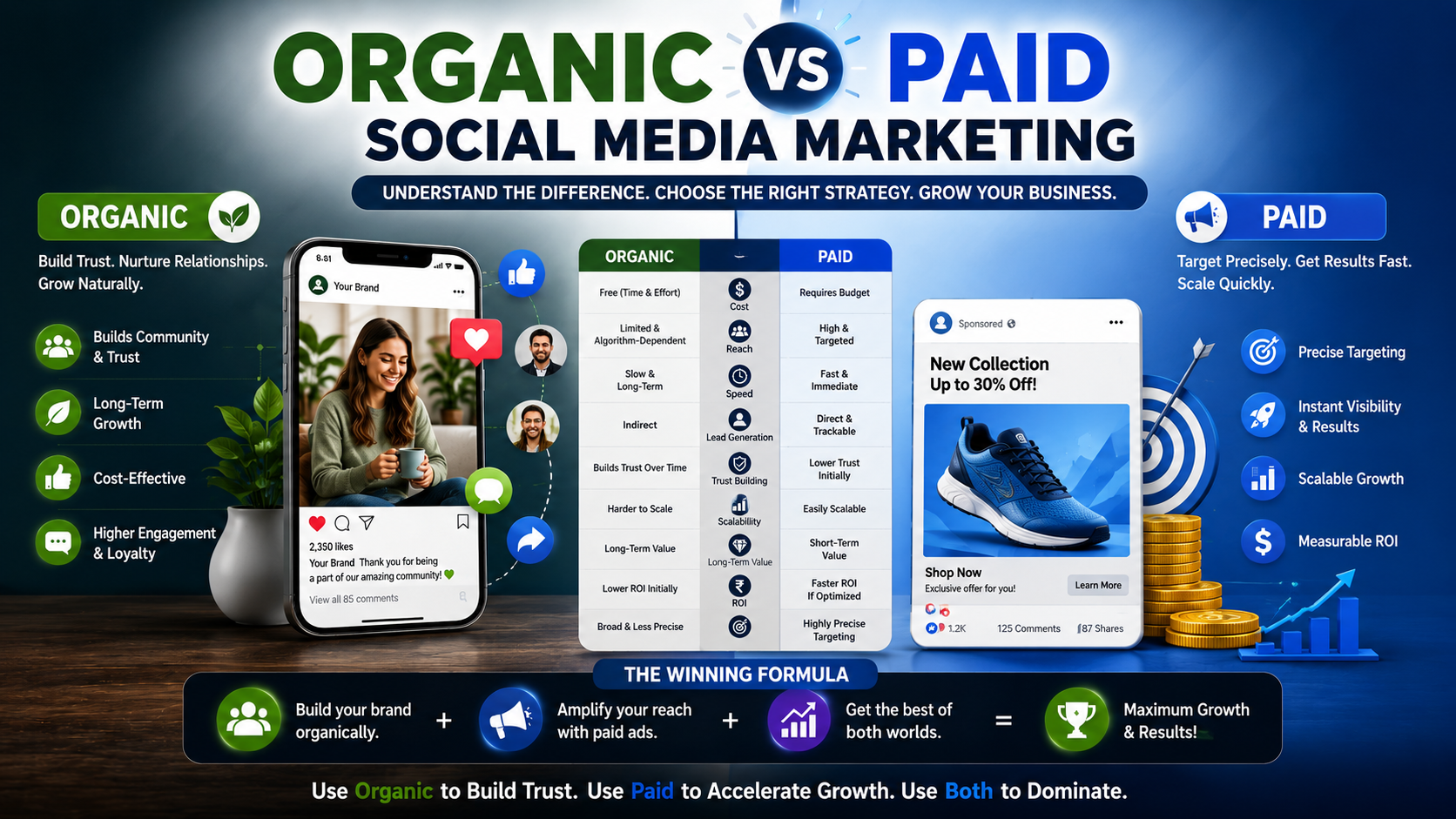
To help you visualize how these strategies contrast, here is a breakdown across core business factors:
Factor | Organic Social Media | Paid Social Media |
Direct Cost | Free to publish (only costs time/production). | Requires ongoing media spend. |
Reach | Limited to followers and a small algorithmic sliver. | Guaranteed placement to targeted non-followers. |
Speed | Slow, iterative, long-term build. | Immediate traffic and visibility. |
Lead Generation | Indirect; relies on profile links and bio calls-to-action. | Direct; uses native forms and landing page clicks. |
Trust Building | High; community perceives it as authentic value. | Moderate; users know they are being sold to. |
Scalability | Hard to scale predictably; tied to algorithm volatility. | Highly scalable by increasing ad budget. |
Audience Targeting | Broad; determined by platform algorithms. | Granular; based on custom data and demographics. |
Primary ROI Metric | Engagement rate, community sentiment, retention. | Cost Per Lead (CPL), Customer Acquisition Cost (CAC), ROAS. |
The answer depends entirely on the specific stage of your customer’s buying journey.
For immediate lead generation and sales, paid social media wins. If you are launching a new software product or opening a new medical clinic, you cannot afford to wait six months for organic SEO or viral social growth to pay your bills. Paid advertising allows you to buy market data and secure immediate customers.
For customer trust and retention, organic social media is the undisputed champion. Modern consumers rarely buy from an ad blindly. When they see a sponsored post for a product, they frequently click through to the brand’s organic profile to check its legitimacy. If your organic profile has zero posts, low-quality graphics, or unaddressed complaints in the comments, that prospect will drop out of your sales funnel.
The Verdict: Paid social media starts the conversation with cold prospects, while organic social media keeps the conversation going to convert them into long-term brand advocates.
Different business models require different resource allocations. The matrix below outlines how specific industries should balance their efforts:
Business Type | Recommended Strategy | Strategic Focus |
Local Businesses (e.g., Cafés, Salons) | Hybrid (60% Organic / 40% Paid) | Use organic for local community building and user-generated content; use paid for hyper-local weekend promotions. |
E-commerce Stores | Paid-Heavy (20% Organic / 80% Paid) | Direct-response paid ads drive the volume of transactions; organic builds the brand lifestyle and aesthetic. |
SaaS Companies | Balanced (50% Organic / 50% Paid) | Paid ads drive demo sign-ups and whitepaper downloads; organic establishes thought leadership on LinkedIn. |
Consultants & Agencies | Organic-Heavy (70% Organic / 30% Paid) | Long-form organic insights prove your expertise; paid retargeting captures high-intent profile visitors. |
Startups | Paid-Heavy (30% Organic / 70% Paid) | Use paid ads to quickly validate product-market fit, secure initial users, and collect feedback data. |
The most profitable digital marketing operations use a unified strategy where organic and paid social media feed into each other. This creates a compounding growth loop.
If a prospect engages with your organic Instagram posts or watches 50% of your organic video content, they have demonstrated interest. You can build a custom audience in your ad manager to show targeted paid promotions exclusively to these warm leads, converting them at a much lower cost per acquisition.
Instead of guessing which ad creatives will perform well, use your organic feed as a testing ground. If an organic post naturally gains 5x more engagement than your baseline average, you know the message resonates. You can confidently put ad budget behind that exact post to transform it into a high-performing paid advertisement.
Paid ads grab attention. Organic content builds familiarity. When a user experiences both, your sales cycle shrinks because the prospect feels like they already know, like, and trust your business before they ever speak with a sales representative.
For an actionable way to deploy this integrated approach across your marketing calendar, consider the following structural framework:
Phase | Strategy Element | Execution Steps | Expected Outcome |
1. The Foundation | Value-First Organic Content | Post 3 high-value, educational, or entertaining pieces weekly on your primary channel. | Establishes brand authority and seeds your custom audience pool. |
2. The Amplifier | Top-of-Funnel Paid Ads | Run video or carousel ads targeted at clear demographic lookalikes to introduce your solutions. | Drives consistent new traffic and cold prospects into your ecosystem. |
3. The Closer | Retargeting Campaigns | Run direct-response paid offers targeted at past profile visitors and website drop-offs. | Converts interested prospects into booked sales and customers. |
4. The Optimizer | Data Review | Weekly analysis of paid ROAS and organic engagement metrics to drop losing assets and scale winners. | Minimizes wasted ad spend and refines your messaging. |
Publishing an organic post does not require a platform fee, but it is not truly free. It requires significant resources, including the cost of copywriting, graphic design, video editing, and strategic planning time.
Yes, provided you understand your numbers. Paid ads are highly effective when you have a clear understanding of your customer lifetime value (LTV) and an optimized conversion funnel. They fail when used as a quick fix for a product or website that does not convert traffic.
If you have more time than money, start by building your foundation with organic content and high-value networking. If you have a marketing budget and need to validate your offer quickly to generate cash flow, lean into targeted paid advertising immediately.
There is no universal number. A practical approach is to start with a modest testing budget—such as $10 to $20 per day per campaign—to collect baseline data on your cost per lead. Once you prove profitability, scale your budget in line with your delivery capacity.
Absolutely. Organic social generates highly qualified leads by leveraging clear calls-to-action in your bio, using direct messaging strategies to converse with active commenters, and sharing highly detailed case studies that prompt readers to reach out directly.
Maximizing your company’s digital growth requires recognizing that organic and paid social media are two sides of the same coin. Organic builds your brand reputation, fosters community loyalty, and establishes long-term equity. Paid social gives you predictable scale, immediate market distribution, and a direct line to new revenue.
Evaluate your current business goals, assess your available capital and time constraints, and use the framework above to build a balanced strategy that drives real business results.